


Oriolus oriolus · vlha obyčajná · Eurasian Golden Oriole
Alternative and historical names
Slovak names
- vlha obyčajná (Kovalik 2010)
- vlha hájová (Kovalik 2010)
- vlha hájová (Matoušek 1990)
English names
- Eurasian Golden Oriole (IOC 2.5 2010)
- Golden Oriole (BOU 1923)
Scientific names
- Oriolus oriolus (AviList 2026)
- Oriolus oriolus (IOC 15.2 2026)
- Oriolus oriolus (IOC 2.5 2010)
- Oriolus oriolus (BOU 1923)
Taxonomic synonyms
- Coracias oriolus (Linnaeus, 1758)
- Coracias spec (Linnaeus, 1758)
- Oriolus oriolus (Linnaeus, 1758)
Birding Slovakia database
This species through our community’s eyes
Species characteristics in Slovakia
- General occurrence
- migrant / M
- Breeding
- common nidificant / Nc
- Migration
- common transmigrant / Tc
- Rarities committee:
- Does not require any reporting or registration by Raritties commitee
Observation map

Detailed species observation statistics

Source: the Birding.sk database. Counts reflect observer contributions, not population size.
About this species
Distribution
It breeds across much of Europe and western to central Asia and winters in central and southern Africa. In Slovakia it is a regular summer breeder, chiefly at lower and middle elevations. It arrives mostly in May and leaves in late summer, especially August and early autumn. Despite the male's bright colours, it is heard more often than seen.
Habitat
It favours open deciduous woodland, floodplain forests, groves, avenues, orchards and large parks with tall trees. Much time is spent hidden by canopy leaves. Flights across gaps or movements at crown edges offer the best views.
Breeding
The deep cup nest hangs in a horizontal fork of fine branches high in a tree. The female usually lays 3–5 pale eggs with dark spots and performs most incubation. Both parents feed the chicks.
Food
It hunts insects and other invertebrates and also eats fleshy fruit. Cherries and mulberries are among the seasonal foods taken directly in tree crowns.
Interesting fact
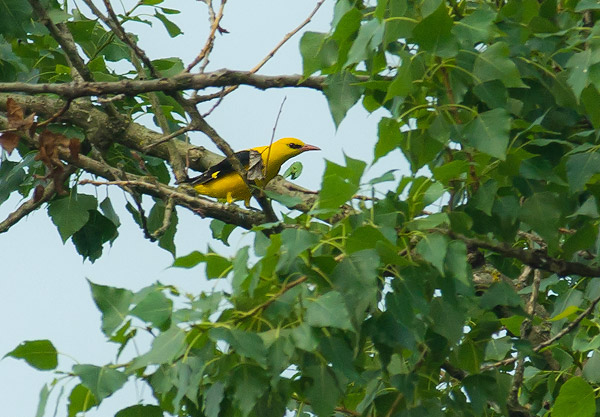
The male's fluting whistles contrast with its harsh alarm call. Yellow plumage blends surprisingly well into green canopy light, so bright colour does not guarantee easy detection of a perched bird.
Sources: Slovak Wikipedia · English Wikipedia · BTO BirdFacts
Sign in to send private feedback on the text to our editors.
Explore further
Overview and identification
Descriptions, identification and names.
- Slovak Wikipedia ↗
Taxon account in Slovak: distribution, biology and references for further reading.
https://sk.wikipedia.org/wiki/Vlha_oby%C4%8Dajn%C3%A1 - English Wikipedia ↗
Taxon account in English: distribution, biology and taxonomic context.
https://en.wikipedia.org/wiki/Eurasian_golden_oriole - BTO BirdFacts ↗
Biology and identification in English; population figures and trends refer to Britain.
https://www.bto.org/learn/about-birds/birdfacts/golden-oriole
























