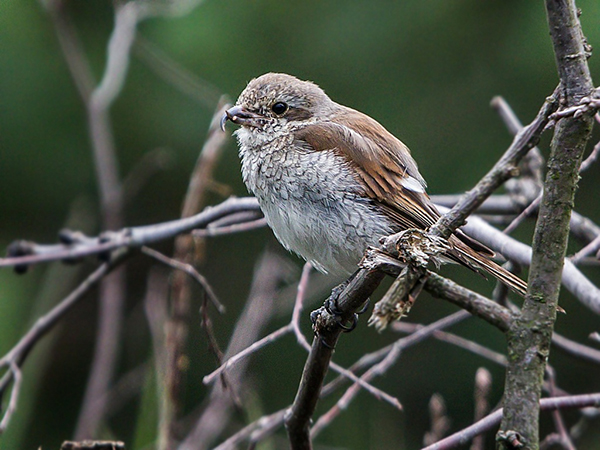
Lanius collurio · strakoš obyčajný · Red-backed Shrike
Alternative and historical names
Slovak names
- strakoš obyčajný (Kovalik 2010)
- strakoš červenochrbtý (Kovalik 2010)
- strakoš červenochrbtý (Matoušek 1990)
English names
- Red-backed Shrike (IOC 2.5 2010)
- Red-backed Shrike (BOU 1923)
Scientific names
- Lanius collurio (AviList 2026)
- Lanius collurio (IOC 15.2 2026)
- Lanius collurio (IOC 2.5 2010)
- Lanius collurio (BOU 1923)
Taxonomic synonyms
- Lanius collurio Linnaeus, 1758
Birding Slovakia database
This species through our community’s eyes
Species characteristics in Slovakia
- General occurrence
- migrant / M
- Breeding
- common nidificant / Nc
- Migration
- common transmigrant / Tc
- Rarities committee:
- Does not require any reporting or registration by Raritties commitee
Observation map

Detailed species observation statistics

Source: the Birding.sk database. Counts reflect observer contributions, not population size.
About this species
Distribution
The Red-backed Shrike breeds across much of Europe and western to central Asia, wintering mainly in eastern and southern Africa. In Slovakia it is a widespread summer breeder from the lowlands to foothill areas. It can be common in suitable places but is absent from uniform landscapes without scrub. It occurs mainly from May to September; winter records are not regular.
Habitat
Typical places include pastures, meadows with thorny bushes, field margins, orchards, woodland edges and young clearings. It often sits on top of a bush or fence, watching the ground. It needs a varied mosaic of shelter and hunting areas.
Breeding
It conceals a nest of grass, roots and twigs in a dense, often thorny bush. It breeds mainly from May to July and usually lays four to six eggs. The female does most of the incubation; both parents feed the chicks and accompany them after fledging.
Food
Large insects, including beetles and grasshoppers, dominate its diet. It occasionally catches small vertebrates. It spots prey from a perch and takes it on the ground or in a short aerial pursuit.
Interesting fact
Despite its hooked bill and hunting style reminiscent of a small bird of prey, it belongs to the songbirds. Its quiet song may include imitations of other birds. The familiar perch on a thorn bush thus serves both a hunter and a singer.
Sources: Slovak Wikipedia · BTO BirdFacts · English Wikipedia
Sign in to send private feedback on the text to our editors.
Explore further
Overview and identification
Descriptions, identification and names.
- Slovak Wikipedia ↗
Taxon account in Slovak: distribution, biology and references for further reading.
https://sk.wikipedia.org/wiki/Strako%C5%A1_oby%C4%8Dajn%C3%BD - BTO BirdFacts ↗
Biology and identification in English; population figures and trends refer to Britain.
https://www.bto.org/learn/about-birds/birdfacts/red-backed-shrike - English Wikipedia ↗
Taxon account in English: distribution, biology and taxonomic context.
https://en.wikipedia.org/wiki/Red-backed_shrike
Data and research
Occurrences, distribution and research.
- BROZ: steppe bird conservation species profiles (Slovak) ↗
Slovak LIFE project species sections and practical habitat measures.
https://broz.sk/projekty/life-4-steppe-birds/ - BROZ: steppe bird conservation species profiles (English) ↗
English LIFE project species sections and practical habitat measures.
https://broz.sk/en/projekty/conservation-and-return-of-steppe-birds-to-lowlands-of-slovakia/