


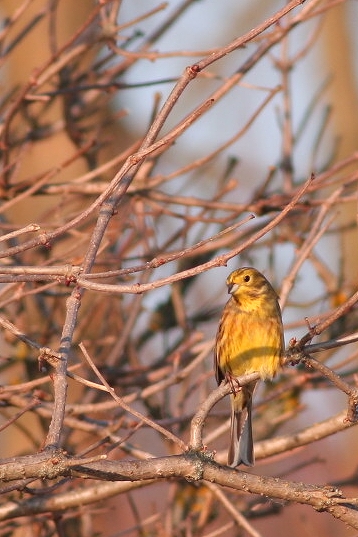
Emberiza citrinella · strnádka obyčajná · Yellowhammer
Alternative and historical names
Slovak names
- strnádka obyčajná (Kovalik 2010)
- strnádka žltá (Kovalik 2010)
- strnádka žltá (Matoušek 1990)
- strnádka obyčajná (Ferianc 1958)
English names
- Yellowhammer (IOC 2.5 2010)
- Yellow Hammer (BOU 1923)
Scientific names
- Emberiza citrinella (AviList 2026)
- Emberiza citrinella (IOC 15.2 2026)
- Emberiza citrinella (IOC 2.5 2010)
- Emberiza citrinella (BOU 1923)
Taxonomic synonyms
- Emberiza citrinella Linnaeus, 1758
Birding Slovakia database
This species through our community’s eyes
Species characteristics in Slovakia
- General occurrence
- resident / R
- Breeding
- common nidificant / Nc
- Wintering
- common wintering / Wc
- Rarities committee:
- Does not require any reporting or registration by Raritties commitee
Observation map

Detailed species observation statistics

Source: the Birding.sk database. Counts reflect observer contributions, not population size.
About this species
Distribution
The Yellowhammer is widespread in Europe and parts of Asia. It is a common Slovak open-country breeder from lowlands to mountain areas. Mainly resident, it forms flocks and moves in search of food during winter. Year-round presence does not mean equal abundance at every site.
Habitat
It uses fields with margins, pastures, bushy meadows, woodland edges and young plantations. Low nesting cover, seed-rich patches and raised song perches are important. In winter it often feeds on stubbles and around farmyards.
Breeding
The female hides a cup nest on or just above the ground, beside a grass tussock or shrub. Usually 3–5 eggs are laid. Both parents feed the chicks, and pairs may breed several times in a season.
Food
Herb seeds and cereal grains dominate outside breeding. Chicks receive mainly insects and other invertebrates collected from low vegetation and the ground.
Interesting fact
Its eggs carry fine dark lines resembling tiny handwriting. This distinctive pattern also occurs in other buntings, although observing birds never requires disturbing nests to look for it.
Sources: Slovak Wikipedia · English Wikipedia · BTO BirdFacts
Sign in to send private feedback on the text to our editors.
Explore further
Overview and identification
Descriptions, identification and names.
- Slovak Wikipedia ↗
Taxon account in Slovak: distribution, biology and references for further reading.
https://sk.wikipedia.org/wiki/Strn%C3%A1dka_oby%C4%8Dajn%C3%A1 - English Wikipedia ↗
Taxon account in English: distribution, biology and taxonomic context.
https://en.wikipedia.org/wiki/Yellowhammer - BTO BirdFacts ↗
Biology and identification in English; population figures and trends refer to Britain.
https://www.bto.org/learn/about-birds/birdfacts/yellowhammer
Sounds, photographs and video
Recordings and visual comparisons.
- BTO: identifying farmland buntings ↗
English comparative identification video covering appearance and vocalisations.
https://www.bto.org/learn/skills/bird-identification/videos/farmland-buntings


