


Anser albifrons · hus bieločelá · Greater White-fronted Goose
Alternative and historical names
Slovak names
- hus bieločelá (Kovalik 2010)
- hus beločelá (Kovalik 2010)
- hus bieločelá (Matoušek 1990)
- hus bieločelá (Ferianc 1986)
English names
- Greater White-fronted Goose (IOC 2.5 2010)
- White-fronted Goose (BOU 1923)
Scientific names
- Anser albifrons (AviList 2026)
- Anser albifrons (IOC 15.2 2026)
- Anser albifrons (IOC 2.5 2010)
- Anser albifrons (BOU 1923)
Taxonomic synonyms
- Branta albifrons (Scopoli, 1769)
- Anser albifrons (Scopoli, 1769)
Birding Slovakia database
This species through our community’s eyes
Species characteristics in Slovakia
- Migration
- common transmigrant / Tc
- Wintering
- common wintering / Wc
- Rarities committee:
- Does not require any reporting or registration by Raritties commitee
Observation map
Detailed species observation statistics

Source: the Birding.sk database. Counts reflect observer contributions, not population size.
About this species
Distribution
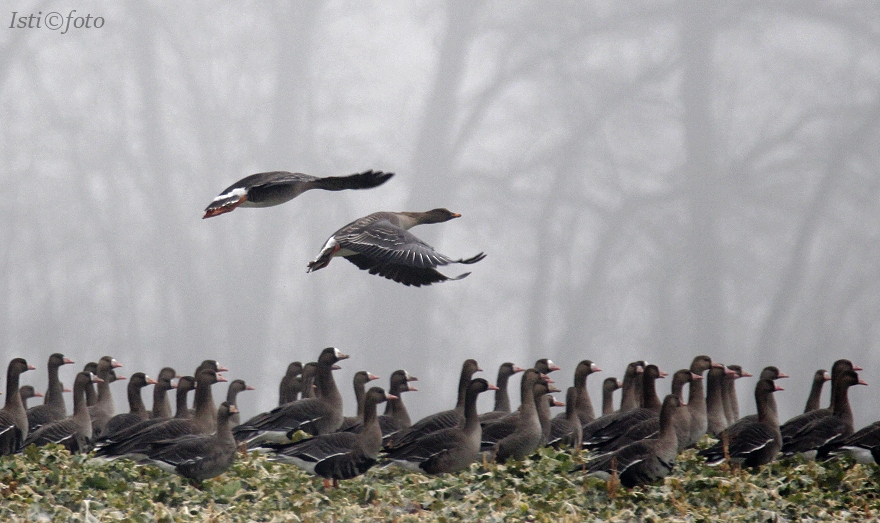
The Greater White-fronted Goose breeds in Arctic Eurasia and North America, moving into milder regions for winter. In Slovakia it is a regular migrant and locally numerous winter visitor, particularly in lowlands near large waters. It arrives in autumn, with conspicuous spring passage in February and March. Numbers vary between winters according to the weather and flock movements. It does not regularly breed here in the wild.
Habitat
It breeds in tundra; wintering areas combine open countryside with safe roosts on water. In Slovakia, look in fields, winter crops and meadows around the Danube and Morava rivers and in the Eastern Slovak Lowland. It may graze far from water by day; morning and evening flights between feeding areas and roosts are conspicuous.
Breeding
On its Arctic breeding grounds it builds a ground nest lined with down. The female incubates while the male remains nearby. Both parents then lead the young, which graze for themselves. This describes its northern breeding cycle, rather than breeding in Slovakia.
Food
It grazes grasses and other green plants. During migration and winter it also feeds on winter crops, seeds and crop remains in fields.
Interesting fact
Young geese initially lack the conspicuous white patch beside the bill and the bold dark bars on the belly. A flock of white-fronted geese may therefore contain individuals that do not yet look particularly true to their name.
Sources: Slovak Wikipedia · BTO BirdFacts · English Wikipedia
Sign in to send private feedback on the text to our editors.
Explore further
Overview and identification
Descriptions, identification and names.
- Slovak Wikipedia ↗
Taxon account in Slovak: distribution, biology and references for further reading.
https://sk.wikipedia.org/wiki/Hus_bielo%C4%8Del%C3%A1 - BTO BirdFacts ↗
Biology and identification in English; population figures and trends refer to Britain.
https://www.bto.org/learn/about-birds/birdfacts/white-fronted-goose - English Wikipedia ↗
Taxon account in English: distribution, biology and taxonomic context.
https://en.wikipedia.org/wiki/Greater_white-fronted_goose - BTO: Identifying grey geese ↗
English identification video comparing this taxon with similar species and explaining distinguishing features.
https://www.bto.org/learn/skills/bird-identification/videos/grey-geese


