


Motacilla flava thunbergi · trasochvost žltý severský · Western Yellow Wagtail thunbergi
Alternative and historical names
Slovak names
No records yet.
English names
No records yet.
Scientific names
- Motacilla flava thunbergi (AviList 2026)
- Motacilla flava thunbergi (IOC 15.2 2026)
Taxonomic synonyms
- ? plexa (Thayer & Bangs, 1914)
- Motacilla flava plexa (Thayer & Bangs, 1914)
- Motacilla tschutschensis plexa (Thayer & Bangs, 1914)
- Motacilla flava thunbergi Billberg, 1828
Birding Slovakia database
This species through our community’s eyes
Photographs by category
Species characteristics in Slovakia
- General occurrence
- migrant / M
- Breeding
- rare nidificant / Nr
- Migration
- uncommon transmigrant / Tu
- Rarities committee:
- Does not require any reporting or registration by Raritties commitee
Observation map

Detailed species observation statistics

Source: the Birding.sk database. Counts reflect observer contributions, not population size.
About this species
Distribution
The northern subspecies of Western Yellow Wagtail occupies mainly northern Scandinavia and northern Eurasia, wintering in Africa and parts of southern Asia. It passes through Slovakia chiefly in spring and late summer. Its breeding stronghold is far to the north. Any local breeding claim requires separate evidence and should not be inferred from the status of the species as a whole or a database label.
Habitat
In the north it breeds in wet open country with low shrubs, tundra and wetlands. In Slovakia it stops on meadows, pasture, fields and shallow shores of large waters. Migrants can form mixed parties with nominate wagtails.
Breeding
The nest is placed on the ground in dense vegetation, often beside a grass tussock. A clutch usually contains 5–6 eggs. Both parents supply the chicks with invertebrates; these details describe nesting within its northern home range.
Food
It mainly catches insects and small spiders from the ground and plants, but can also take prey in a short aerial sally.
Interesting fact
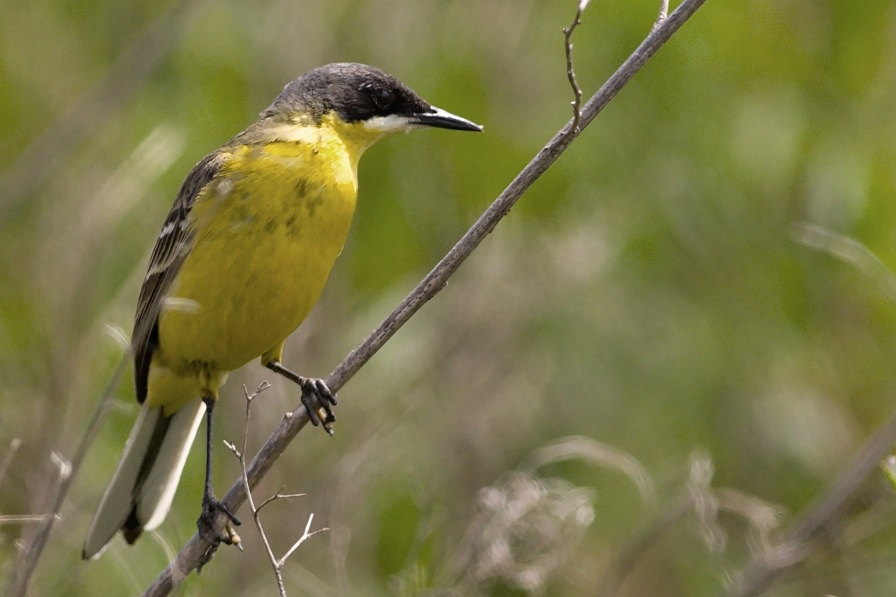
A male has a dark grey head, often almost black cheeks, and usually no white eyebrow. Separation from other dark-headed subspecies requires assessment of the throat, head and the full range of plumage variation.
Sources: English Wikipedia · BTO BirdFacts
Sign in to send private feedback on the text to our editors.
Explore further
Overview and identification
Descriptions, identification and names.
- English Wikipedia ↗
Taxon account in English: distribution, biology and taxonomic context.
https://en.wikipedia.org/wiki/Western_yellow_wagtail - BTO BirdFacts ↗
Biology and identification in English; population figures and trends refer to Britain.
https://www.bto.org/learn/about-birds/birdfacts/yellow-wagtail
Sounds, photographs and video
Recordings and visual comparisons.
- BTO: identifying yellow-coloured wagtails ↗
English comparative identification video covering appearance and vocalisations. Parent-species comparison; does not independently diagnose this subspecies.
https://www.bto.org/learn/skills/bird-identification/videos/yellow-coloured-wagtails


