


Pernis apivorus · včelár lesný · European Honey Buzzard
Alternative and historical names
Slovak names
- včelár lesný (Kovalik 2010)
- včelár obyčajný (Kovalik 2010)
- včelojed obyčajný (Kovalik 2010)
- včelár lesný (Matoušek 1990)
- včelár obyčajný (Ferianc 1987)
English names
- European Honey Buzzard (IOC 2.5 2010)
- Honey-Buzzard (BOU 1923)
Scientific names
- Pernis apivorus (AviList 2026)
- Pernis apivorus (IOC 15.2 2026)
- Pernis apivorus (IOC 2.5 2010)
- Pernis apivorus (BOU 1923)
Taxonomic synonyms
- Falco apivorus (Linnaeus, 1758)
- Pernis apivorus (Linnaeus, 1758)
Birding Slovakia database
This species through our community’s eyes
Species characteristics in Slovakia
- General occurrence
- migrant / M
- Breeding
- common nidificant / Nc
- Migration
- common transmigrant / Tc
- Rarities committee:
- Does not require any reporting or registration by Raritties commitee
Observation map

Detailed species observation statistics

Source: the Birding.sk database. Counts reflect observer contributions, not population size.
About this species
Distribution
Honey-buzzard breeds across much of Europe and western Asia and winters in sub-Saharan Africa. In Slovakia it is a widespread but inconspicuous migratory woodland breeder. It arrives mainly in April and May and leaves in late summer and autumn. Similar size alone should not lead to confusion with year-round Common Buzzards outside that period.
Habitat
It favours deciduous and mixed forests with clearings, meadows and edges suitable for social insect nests. Ground feeding keeps it hidden; display and migration flights make it more conspicuous above woodland.
Breeding
A tree stick nest is built or refurbished with fresh green material. Both partners incubate usually two eggs and provision chicks.
Food
It specialises mainly in wasp larvae and pupae excavated from underground nests, also taking other insects and occasional small vertebrates. Its name does not imply exclusive bee hunting.
Interesting fact
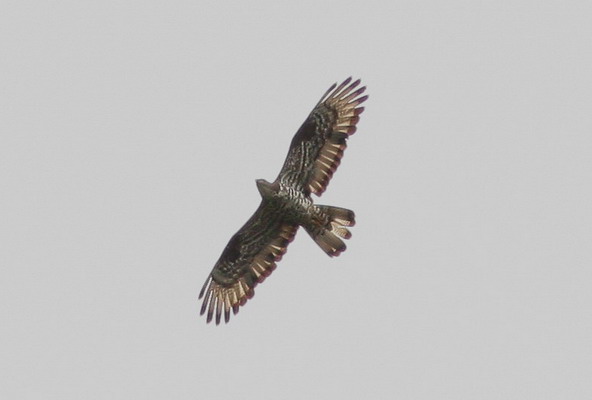
Displaying birds raise their wings above the back in a clapping action. A small head on a longer neck and tail pattern help separate it from Common Buzzard.
Sources: Slovak Wikipedia · English Wikipedia
Sign in to send private feedback on the text to our editors.
Explore further
Overview and identification
Descriptions, identification and names.
- Slovak Wikipedia ↗
Taxon account in Slovak: distribution, biology and references for further reading.
https://sk.wikipedia.org/wiki/V%C4%8Del%C3%A1r_lesn%C3%BD - English Wikipedia ↗
Taxon account in English: distribution, biology and taxonomic context.
https://en.wikipedia.org/wiki/European_honey_buzzard - BTO: Identifying Common Buzzard and Honey-buzzard ↗
English identification video comparing this taxon with similar species and explaining distinguishing features.
https://www.bto.org/learn/skills/bird-identification/videos/summer-buzzards-common-buzzard-and-honey-buzzard
Data and research
Occurrences, distribution and research.
- State Nature Conservancy: identification, ecology and conservation – Pernis apivorus ↗
Slovak expert profile with morphology, ecology and species conservation information.
https://www.biomonitoring.sk/Registration/AtlasAnimal/Detail/48828
























